

“We need to build more in Britain. We need to be unapologetic about saying that is a national priority.”
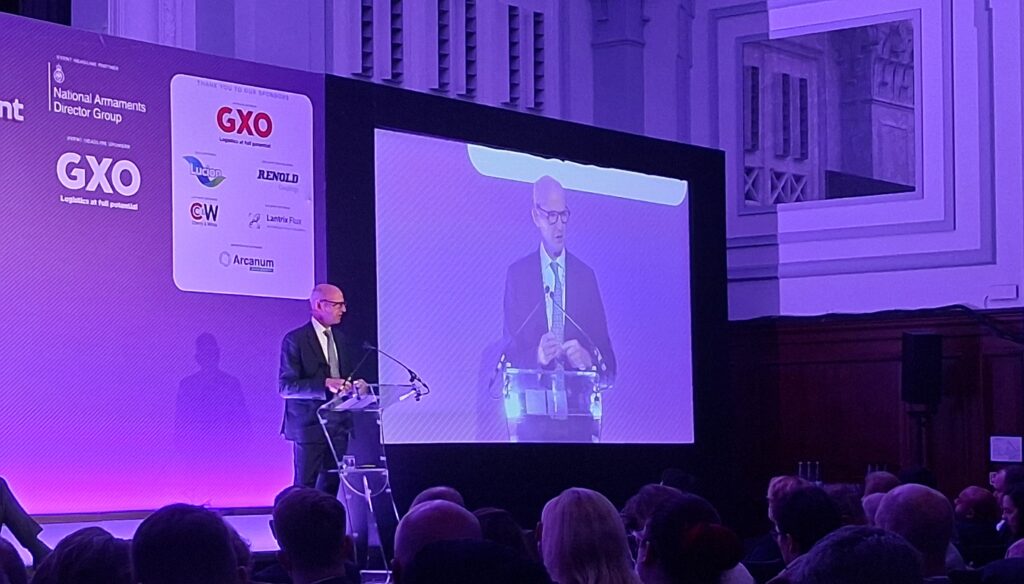
In his keynote speech, Luke Pollard MP, Minister for Defence Readiness and Industry, set the scene for the DPRTE UK National Defence Procurement & Supply Chain Summit.
And British manufacturing’s role in transforming defence capability has never been more in focus.
Taking place at the Kimpton Clocktower Hotel in Manchester on October 22, the summit covered The Defence Investment Plan (DIP), export opportunities, changes to the procurement process, commercial reform, the role of mid-tiers, the current strategic defence landscape and much more over a range of speeches and panel discussions.
As a Make UK Defence Fit for Defence partner – and as a company supporting several businesses in the defence supply chain – Horizon Works was there to hear insights from across Government and industry.
So what were our key takeaways from the DPRTE UK National Defence Procurement & Supply Chain Summit?
Procurement acceleration is real
Luke Pollard called for removing the restrictions “that slow you down and slow us down” in his keynote.
But what does that mean in practice?
Helen Bates, Commercial Director, National Armaments Director Group, shared progress that is already being made on this, stressing that “security clearance should not be a competitive advantage”. She also referenced seven new commercial pathways launched over the last 12 months, including SME and science and technology pathways, in an effort to move on from the ‘one size fits all’ standard procurement approach to acquisition methodology.
Kelly Maddison, Interim Director-General of Make UK Defence, also pointed to the MOD’s work in reducing the time it takes to get large programmes out to contract from six to two years. “That’s a huge step forward, and that will then benefit the rest of the supply chain.”
And she praised the work of CommercialX, the MOD’s programme for accelerating procurement of digital and innovative technologies.
Mid-tiers as a gateway to SME growth
In one of the most fascinating sessions of the day, the role of mid-tiers – or “the forgotten middle” – was put into sharp focus. In a panel featuring Anthony Hammond, Divisional Managing Director (Joint) of Hyde Aero Products, there was discussion on why mid-tiers were more accessible than Primes, due to shorter qualification timescales, easier to reach commercial teams and their strategic need to grow.
Anthony offered valuable advice for SMEs looking to engage with mid-tiers, emphasising the importance of apprentice schemes, continuous improvement and financial stability. “Your mid-tier customer isn’t just looking for your product or your service. They’re also looking for confidence.”
The importance of communicating capabilities
As an industrial marketing company, we would always advise you tell your story and build a compelling brand narrative.
And it was good to hear Nathan Partington, Founder and CEO of NPD Studio, reniforce the importance of communication. An article on the company’s website was found by BAE Systems via Google. The result? NPD now has on office on BAE’s Warton site, and it has supported BAE in modernising the simulator avionics for the Typhoon fighter jet programme.
“If you want to progress, you’ve got to be prepared to tell your story and keep telling it. One post on LinkedIn a month isn’t going to isn’t going to do it. Be visible and keep telling your story until the right person sees it.”
Wise words Nathan!
Networking and collaboration
Several speakers emphasised the role of membership organisations and the burgeoning Regional Defence and Security Clusters, in creating interfaces for the defence supply chain, and the importance of relationship building.
“I always say a trade body or a defence security cluster is like a gym membership,” said Samira Braund, Defence Director of ADS Group, in the working with mid-tiers session. “You get out what you put in. There are lots of opportunities to network, to meet the customer, the MOD, the frontline commands, the mid-tiers. But you have to make that step forward.”
For Anthony Hammond, “The aerospace and defence industry is not at all transactional. It’s very about people and relationships”.
And when asked what the most important thing a business could do in helping to turn the DIP into a pipeline of programmes that provide “certainty and longevity” the message from Kelly Maddison, was clear: “Collaborate. Collaborate with each other in the room, company to company, with trade associations, with the Regional Defence Clusters.
“We’re ultimately here to improve the UK’s defence supply chain, and we can do that much easier when we work together.”
Want to grow in defence? Find out how we’re breaking down barriers, shaping powerful messaging and bringing our industrial marketing expertise to the defence supply chain here.